Products
Five product lines, one colour standard.
Whether the specification calls for a 0.4 mm PVC edge on a flat-pack shelf or a 2 mm acrylic return on a hotel reception desk, the shade underneath should be the same.
Request data sheets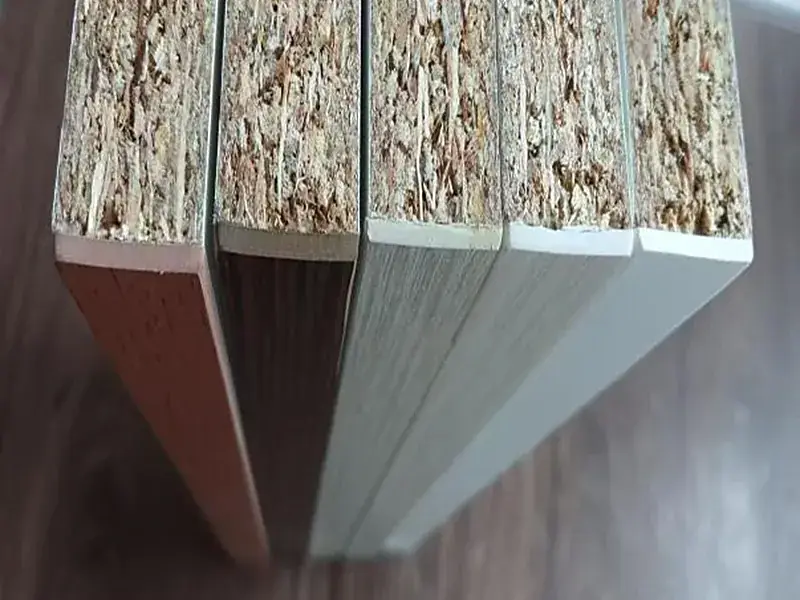 01 — PVC
The workhorse
PVC edge banding
The default choice for cabinet doors, panels and shelving: dense, consistent, easy to trim, and available in every finish we make.
Our PVC is extruded from virgin compound rather than regrind, which keeps the colour even through the thickness and makes the trimmed edge look the same as the face. For high-traffic surfaces we recommend 1.0 mm and above; for flat-pack and shelving, 0.4–0.8 mm.
| Thickness | 0.4 / 0.5 / 0.8 / 1.0 / 1.2 / 1.5 / 2.0 / 3.0 mm |
|---|---|
| Width | Up to 64 mm (slit to your board thickness plus 1–2 mm) |
| Finishes | Matte, super-matt, high-gloss, embossed woodgrain, soft-touch, metallic |
| Colours | 1,200+ decors, or matched to your board |
| Roll length | 100 m or 200 m per roll |
| Minimum order | 3,000 m per colour and size |
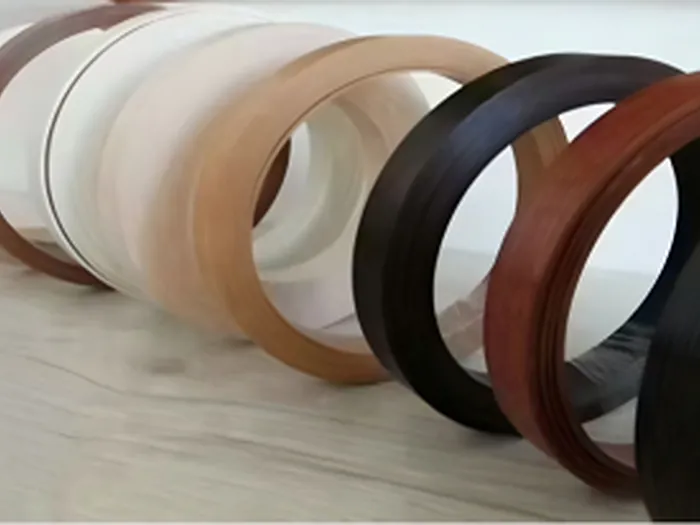
Common finishes
 02 — ABS
No plasticizer
ABS edge banding
For furniture that has to survive knocks, and for buyers who have to answer questions about what is in the material.
ABS is plasticizer-free, so it does not migrate into the board or release odour in a closed wardrobe. It takes impact better than PVC at the same thickness and cuts cleanly, which is why it is common in contract and children's furniture. We run it through the same colour library, so an ABS edge can sit next to a PVC face with no visible drift.
| Thickness | 0.8 / 1.0 / 1.2 / 1.5 / 2.0 mm |
|---|---|
| Width | Up to 64 mm |
| Properties | Plasticizer-free, high impact, low odour, good colour stability |
| Finishes | Matte, super-matt, embossed woodgrain, high-gloss |
| Roll length | 100 m or 200 m per roll |
| Minimum order | 3,000 m per colour and size |
 03 — Acrylic
Depth of colour
Acrylic edge banding
A high-gloss edge with the same visual weight as a lacquered door or a solid-surface worktop.
PMMA has a clarity PVC cannot imitate: the colour sits deep under a hard, polished surface. It is the finish for retail interiors, hospitality joinery and kitchens where the edge is meant to be noticed. The surface is UV-stabilised and holds its gloss better than a coated tape, though we still recommend a protective film for fabrication.
| Thickness | 1.0 / 1.2 / 1.5 / 2.0 mm |
|---|---|
| Width | Up to 64 mm |
| Surface | High gloss, UV-stabilised, scratch resistant |
| Colours | Matched to solid colours, lacquers and high-gloss boards |
| Roll length | 50 m or 100 m per roll |
| Minimum order | 3,000 m per colour and size |
Surface character
Soft-touch & 3D surfaces.
A matte surface that resists fingerprints, and textures you can feel before you see. The fastest way to make a standard board feel premium.
Four surface families
Super-matt
A low-sheen lacquered surface at around 3–5 gloss units, with anti-fingerprint treatment.
Soft-touch
A velvety hand that hides small scratches and reduces the cold feel of plastic.
3D embossed
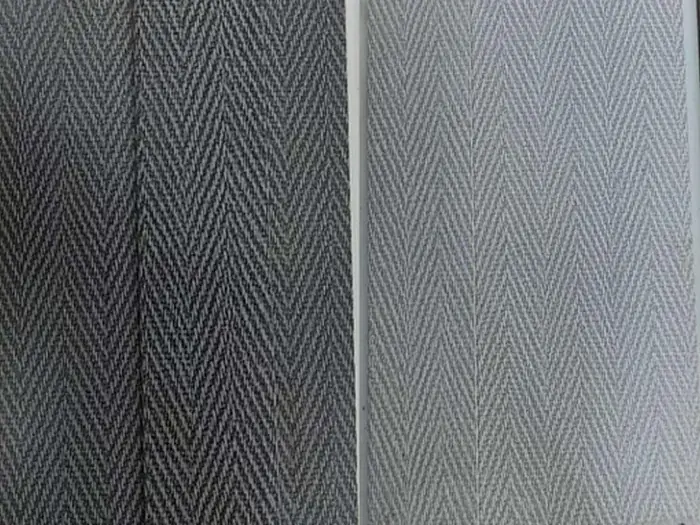
Deep grain and herringbone structures, registered to the board's decoration.
Metallic
Brushed and pearl effects for display and hospitality joinery.
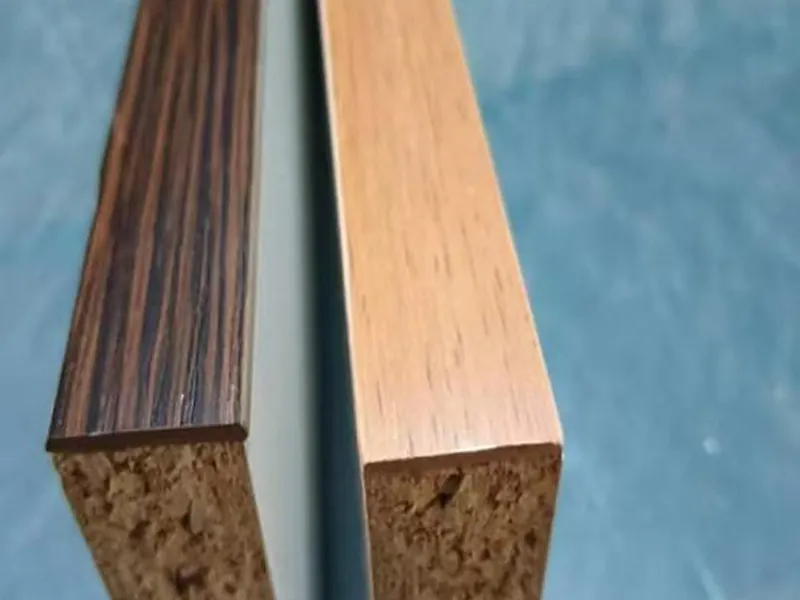 05 — Profiles
Custom sections
Profiles & U-channel
For the cases a flat tape cannot solve: tabletop edges, soft-close returns, drawer fronts and panels that need a finished edge on both sides at once.
We extrude U-channels, soft-edge and T-profiles, and tabletop edging to your drawing, in the same compound and the same colour as your flat edge banding. Tooling is shared across colours, so a custom section does not mean a custom colour.
| Sections | U-channel, soft-edge, T-profile, tabletop edging |
|---|---|
| Thickness | 1.0–3.0 mm wall, depending on section |
| Width / opening | 8–60 mm; drawn to your panel thickness |
| Colours | Matched to the flat range, including woodgrain |
| Tooling | New sections quoted on drawing; existing sections available from stock |
| Minimum order | Quoted per section — typically 3,000 m |
How to specify
Four decisions, in this order.
Most specification errors happen in the first two. Get the thickness and width right and the rest is a matter of taste and budget.
Thickness
0.4–0.8 mm for flat-pack and shelving; 1.0–2.0 mm for doors and high-traffic surfaces; 3.0 mm for a deliberate heavy edge.
Width
Board thickness plus 1–2 mm for trimming. On a calibrated panel, 2 mm is the safer allowance.
Finish
Match the board's gloss level. A matte edge on a gloss board reads as a defect; both should be specified together.
Colour
Send the surface. Photos and screen colours are not a reference — a 100 mm offcut is.
Documentation
A data sheet and a sample set, by courier.
Tell us the board you are using and the finish you have in mind. We will send the current data sheets and matched samples; samples are free, you cover the courier.