Quality & testing
Edge banding fails quietly.
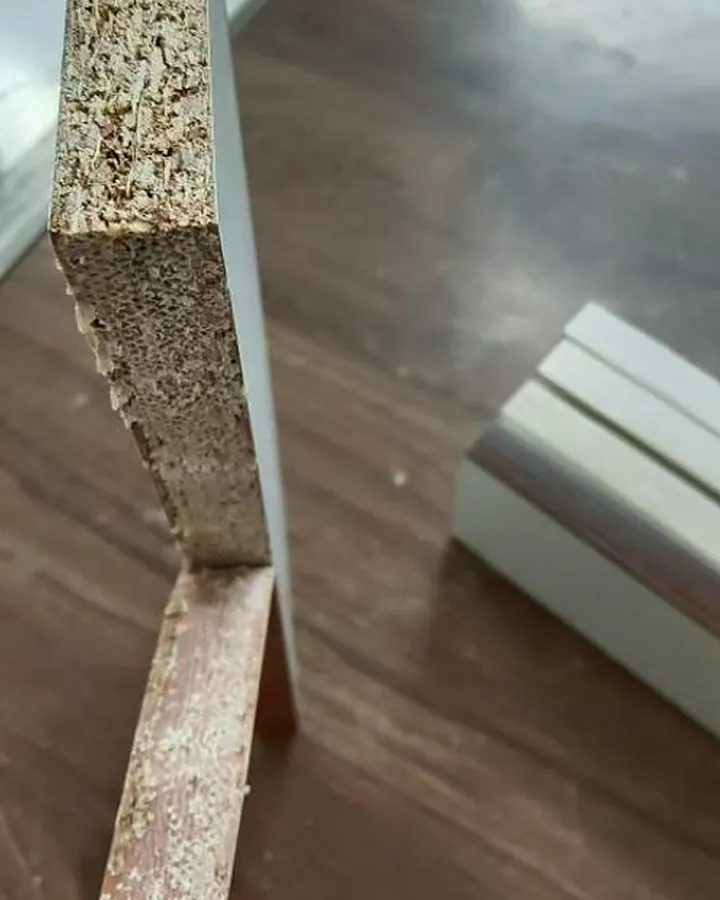
A lifted corner after a heating season. A shade that yellows beside a window. A roll that measures 0.75 mm. Our checks exist to catch those failures before a container is booked, not after a claim.
Process control
Six points where the edge can go wrong.
Each stage has a measured pass condition and a recorded batch number. If a problem appears downstream, we can trace it back to the compound lot and the machine run.
Incoming compound
Virgin PVC and ABS checked for lot, colour and moisture before it is allowed into the extruder. No regrind in face layers.
Extrusion & gauging
Thickness measured continuously; a laser gauge alarms outside ±0.05 mm. First-off samples are kept per run.
Printing & lacquering
Grain registration checked against the master decor; gloss level measured on every batch of super-matt and high-gloss.
Slitting & winding
Width checked against the order, roll tension set so the tape feeds without curling, splices marked and counted.
Colour verification
Batch strips compared to the approved standard in a controlled light booth, under both warm and cool light, by two people.
Packing & loading
Cartons lined against moisture, pallets braced, container loaded and photographed before the doors close.
Test list
What we measure, and to what limit.
Typical internal limits for standard PVC and ABS production. Customer-specific limits are written into the order and checked against them.
| Test | What it catches | Typical limit |
|---|---|---|
| Adhesion / peel | Edge lift after glue cure, especially on U-profile returns | No lift at 90° peel, per glue supplier's data |
| Surface wear | Scuffing and polish loss in high-traffic areas | Taber, 500 g / 100 cycles — no breakthrough |
| Colour fastness | Yellowing and shade drift beside windows and under retail lighting | Grey scale ≥ 4 after 100 h xenon arc |
| Thickness | Thin rolls that trim short or telegraph the board | ±0.05 mm on nominal gauge |
| Cold bend | Cracking during winter transport and cold-weather fabrication | No crack at 0 °C, 180° bend on 0.8 mm |
| Impact | Chipping on door edges and drawer fronts | Falling-dart, no shatter at 1 m on 1.0 mm ABS |
| Migration / staining | Plasticizer bleeding into the board or paint | No staining after 72 h at 70 °C |
| Dimensional stability | Curling, shrinkage and width drift in storage | ≤ 0.3% length change after heat cycle |
Limits shown are typical for standard production. Each batch record states the method used and the value measured.
Documentation
What we can put in writing.
Buyers need evidence, not assurances. Every batch is recorded against its colour standard and gauge, and the documents below can travel with a shipment — tell us at order stage which ones your customer requires.
Batch records
Compound lot, machine run, gauge and width log, colour standard and operator, filed against the carton label.
Inspection results
Thickness, width and colour checked against the retained standard, with the measured values written on the batch record.
Shipping documents
Packing list, carton labels, roll lengths and gross/net weights, matching what is actually loaded.

Packing
Protection is part of the specification.
Edge banding is light and bulky, and a crushed carton means a rejected roll. Packing is specified as carefully as the tape itself.
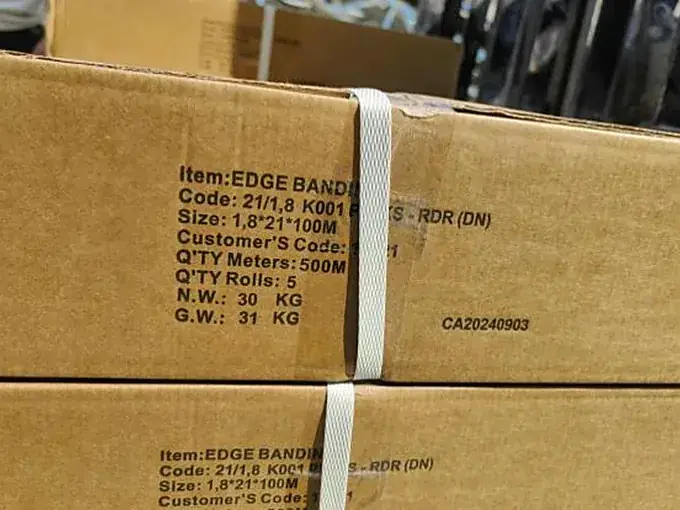
| Roll | 100 m or 200 m, wound on a core, taped end, moisture-barrier film |
|---|---|
| Carton | 5-ply corrugated with internal liner; product code, size and colour on the label |
| Pallet | Palletised and strapped, corner-protected, stretch-wrapped |
| Private label | Own-brand cartons and labels from 1,000 m per size |
| Loading | Container loading photographed and reported before shipment |
Mixed containers are possible: colours, sizes and product lines can be combined to reach the minimum order value.
Claims
If something is wrong, we want the roll back.
Send the batch number, a photo and the roll label. We investigate against the retained first-off sample and answer with a replacement or credit, not a debate.